Mostrando postagens com marcador Articles (English Version). Mostrar todas as postagens

quarta-feira, 8 de fevereiro de 2023

Nemophila - Oiran & Raitei: dynamite gunpowder


Hello my dears. I am the Raven who speaks to you.

In today's “Melodiam Corvidae”, I will talk about “Nemophila”, an all-female japanese metal band. The name is not so strange for those who like flowers, after all the species is much more common in the american continent than in Japan, which is curious. But the name makes sense, given the five petals that the plant has (same number of band members, as is traditional in projects with twin guitars). The term “nemophila” is formed by the junction of two greek words: the first is nemus, which means grove. And the second, much easier to remember, is philos which means love or loving. It's a very girly thing to create a band named after a flower, right? But don't judge the girls before you hear them: their sound is powerful, in-your-face and full of attitude. Unlike many other japanese female bands that care too much about the looks, “Nemophila” doesn't want to know about any of that. Their thing is T-shirts, jeans and a sonic thump coming out of their amplifiers. They just want to have fun playing the most straight forward and traditional metal possible.

Although some of the faces are recognizable to heavy music listeners, after all some of them have long experience in the japanese scene, “Nemophila” is relatively new. The band was formed in mid-2019 by experienced guitarist Saki and vocalist Mayu. Being realistic, it is impossible to talk about “Nemophila” without talking a little more about Saki, in particular. Because without her the band would not be possible, in my opinion. It is Saki who really opens doors for having a more consolidated and respected name in the japanese music industry.

Let's go back a little to the past. In the mid-2000s, a female band called “Destrose” appeared in Japan and, it must be said, in a completely unfavorable scenario for them in terms of the market. These were girls with a strong passion for rock and metal, but who didn't necessarily have a niche or cultural segment in Japan that could embrace them. Both “Destrose” and the better known “Aldious”, in their early days, faced many difficulties before getting a little more media attention. “Aldious” is still active, as you may know. But “Destrose” had 10 years of productive work. Although they had a solid sound, one of the band's biggest problems was the excessive change of members. Lots of girls coming in and out of the band. The ones that were most successful in the market were undoubtedly those that endure for a long time. The recognition began to be proportional only in recent years, already in current projects, but it is undeniable that the years of “Destrose” certainly gave them a lot of credibility.

But what does this have to do with Saki, our focus? It has and a lot. Because if her and Destrose's fate hadn't crossed, many opportunities might not have arisen. It all started precisely in this constant exchange of members. In one of these opportunities, Saki ended up assuming the position of Destrose's solo guitarist between 2009 and 2010, which made her create friendship bonds with the band and also meet more people from the female rock circle (which in Japan, is almost like a little club; the country is very small, I remind you). “Destrose” only ended activities in 2015, when bassist Miho and drummer Haruna decided to follow their own path by forming one of the most relevant female bands in japanese metal today, “Lovebites” (which has already played in the main european festivals, including Wacken Open Air). But it wasn't the first time that “Destrose” gave birth to another band that would become bigger: there was also “Mary's Blood”, formed in 2009. Although Miho and Haruna have their names strongly associated with Destrose's history, they are actually part of of the second generation of the band. Vocalist Eye and drummer Mari were from the previous generation, as was guitarist Eri, who stayed with “Mary's Blood” until 2012 and then decided to quit. It was then that the others remembered Saki and invited her to be the band's permanent guitarist.

Saki is undoubtedly very talented in not only playing but also writing music. And it's no wonder that she gets involved with a lot of projects at the same time. Prior to the hiatus announcement (which could possibly be permanent), Saki was playing with “Mary's Blood” and “Nemophila” at the same time. But she still shared time in another project with the former bassist of the band DragonForce, called “Amahiru”. However, as Saki herself states in the past, with “Nemophila” she can have a little more freedom to do whatever she wants, because although she is one of the main composers of “Mary's Blood”, the fact that the band is older and more consolidated implies a specific type of sound and appeal, desired by its audience. Some invisible ties and other responsibilities that are very noticeable to the eye end up forming within a popular band, after all it is not just a group of musicians, but also a brand, a company.

Founding “Nemophila” with Mayu was like going back to garage days, to rehearsals after school. And that's exactly what “Nemophila” looks like and also sounds like. Just check the covers and other videos they publish on Youtube. Some years back these ladies expected to hit the road and promote their two singles a little more, called “Oiran” and “Raitei”. But with the pandemic scenario, their plans all went down the drain. The interesting thing is that even in the calamity, this did not take away from them any enthusiasm. In addition to the sound of the band being very good, what also attracted me was the amount of satisfaction they get when playing together. Whether at home, in the studio, at online concerts or with the participation of pioneers of heavy female music in Japan, like drummer Mittan from the band “Show Ya”, they always seem to be having the time of their lives.

There is almost nothing negative about “Nemophila” in terms of entertainment and sound quality for lovers of the genre. When Mayu started working with Saki, she was looking for work opportunities. Mayu has a very distinctive timbre, which I think is essential in a vocalist. She likes dirty vocals, but also sings cleanly and in tune. Her vocal spectrum is limited and doesn't reach such high notes. However, her style is very characteristic and certainly different from what we are used to hearing in the scene. Her timbre is serious, but curiously smooth at the same time. The dirty vocals, arising from her taste for metalcore, lack tone, but at the same time are very particular to her. If you hear Mayu talking or singing, you'll automatically know it's her without having to see her. “Smooth dirty vocals” is the expression I can think of to describe the way she sings. She's not Angela Gossow, Alissa White-Gluz or Tatiana Shmailyuk: her growls don't have as much strength and aggression. But that's exactly what's interesting about Mayu's vocals, this softening that is quite unusual. In terms of clean vocals, in addition to the bass that characterizes her voice, Mayu works very well with intonation: she attacks syllables, puts punch, strength in singing. Vocally, she is a hybrid between punk and metalcore.

Accompanying Saki on guitars, we also have Hazuki as a soloist. And like Saki, this girl plays a lot, see? Particularly, I didn't know her very well, but in recent years she appeared on the net accompanying the band of the little prodigy Lisa-X, who I have followed since she was a little girl and already published videos playing songs by virtuosos like Paul Gilbert and John Petrucci on Youtube. To play with Lisa, you need to have absurd guitar skills and Hazuki does not disappoint. When I realized she was a member of “Nemophila”, I was pretty sure that was something I'd want to hear. Just like Saki, Hazuki likes powerful riffs, bold and melodic solos, as the good old metal book of the eighties dictates. The two together are gunpowder for dynamite.

Bassist Haraguchi is a relative newcomer among these veterans, but her intensity and enthusiasm on the four strings is simply a delight. Haraguchi is not the type of bass player to hide, but one who joins the party, filling the loud guitars with screeching metallic strums. Drummer Murata Tamu is the most discreet of the five ladies, but certainly one of the best heard. And largely because of the fact that she is a multi-instrumentalist (having a broader musical vision and a perspective that goes beyond percussion). The fact that she acts more as a drummer puts her in the role of leading the rest of the band, which she does in a precise way and dosing the energy and speed of the others in the right measure. Instrumentally, Murata Tamu has very good taste and it's not a mere coincidence that her musical preferences are for bands like “Dream Theater” and “Opeth”. “Nemophila” really works on a group contribution and everyone helps write the compositions, which leaves Saki in a much more comfortable and less burdened position. But of all the members, Murata Tamu is perhaps the musician with the most autonomy to fill in the contributions provided. As “Nemophila” is far from having the progressive sound that the drummer likes the most, it is through her small touches that metallic compositions come out of the common sense. Although the songs are very traditional in terms of heavy metal, there is always some surprise in the course of the tracks presented in the singles “Oiran” and “Raitei”, in instrumental terms.

I hope “Nemophila” lasts a long time. They really enjoy being together and, as a result of this, at the interpersonal level, of relationships, the prognosis is very good. It remains to be seen whether the japanese market will allow many of these interesting bands that have emerged in the country to survive. Personally, I hope so. The freshness and enthusiasm of japanese metal is always a welcome and necessary counterbalance to the infertile and stuck sound of western bands. It is important for sporadically breathing new life into the genre and presenting other perspectives that honor the past, while still looking to the future. It was no wonder that the legendary Marty Friedman left “Megadeth” for a musical life in Japan. From a financial point of view, a much more modest decision, but from an artistic point of view... I can understand it perfectly.

Corvid greetings!

quinta-feira, 2 de fevereiro de 2023

Band-Maid - Unseen World: instrumental maturation


Hello my dears. I am the Raven who speaks to you.

To listeners who have never heard me talk about Band-Maid, I clarify that I do not base my evaluations on the appreciation I have for a band. Unlike fandoms, I've never been willing to uncritically accept everything artists do. My tone is normally demanding on what I think needs some criticism. However, I don't like to criticize just for the sake of criticizing. And it was with a lot of demand that I listened to “Unseen World” from the first stanza of the opening song, called “Warning”, to the closing of “Black Hole”. I was determined to listen to much more than what Band-Maid has traditionally offered in previous years and I wouldn't be generous with them if I found exactly the same standard of quality as the previous album, called "Conqueror".

“Conqueror” was not an album that convinced me for a number of reasons. The japanese are culturally workaholics and in many situations, for their art to become more refined and for them to be able to extrapolate the standard of quality they usually set, it is necessary to stop a little. Reflect and review some concepts, update yourself and go back to studying. Band-Maid, in the years leading up to "Unseen World", didn't have time for that. The band was busy between shows and interviews, marketing the brand tirelessly as much out of necessity as it was demand. After all, they were signed to the Nippon Crown label and its subsidiaries, who also made demands in terms of publicity. Kanami Tono, the band's guitarist and songwriter, wrote the songs for “Conqueror” in her rare spare time. And this lack of time to work intensely on the compositions contributed to the fact that the album, although of an average level and with some good compositions, was lacking in a central concept. What definitely doesn't happen here, with “Unseen World”: now we really have an ALBUM and not just a bunch of random produced songs. "Unseen World" has a completely enlightened musical direction, with the band aware of what they want for themselves musically. Here we have an album in the literal sense of the word, and not a tangle of tracks like we had in “Conqueror”. “Unseen World” is a planned, thoughtful album, with a defined musical direction and that requires a considerable effort from all band members to execute it. And the fact that Band-Maid was on the sidelines for the entire year of 2020, with absolutely nothing to do but work on writing new music, certainly helped a lot in this regard. “Unseen World”, in addition to being mature, is musically intelligent, technically challenging and very savvy about its own intensity. In my opinion, this album could easily be called “Band-Maid”, but the title “Unseen World” points to the desire to visit places that they haven't been able to. And I say that because this album is a charter of what Band-Maid is and what they do best, something that Nippon Crown and its subsidiary, Revolver Records, were corrupting and endangering.

When I previously heard the single called “Different”, I also mentioned how much Kanami Tono was overly hidden in the mix made by Revolver Records. And also how the latest compositions were flirting excessively with j-pop, being forced into the mainstream, when in fact Band-Maid didn't even need it. Their songs have always been accessible, one way or another. The label's demands were turning Band-Maid into an overly fancy band, far removed from Miku's original concept and Kanami's musical preferences. I strongly criticized the sound production, the sound engineering of “Conqueror” and also of “Different” - the record company should get on track and stop blowing up the band’s songs, because the compositions were good, but were underused due to weak mixing and forced into the mainstream.

When I heard the first two tracks of “Unseen World”, I was immediately blown away. I thought: “wait... this is too good. Misa and Akane are on point, as loud as ever, but now Kanami's guitar sound is as powerful as theirs. They finally brought it to the front of the mix, exactly how I wanted it. The sound is impeccable. This cannot be the work of Revolver Records. It can not be." So I checked to see if the band was in fact still with Revolver and found out that the album was produced by another company, Pony Records. Mystery solved! And I thank heaven for that! Nippon Crown is pretty big in Japan, much bigger than Pony Records. Band-Maid, by the way, when joining the latter, becomes one of the main names of the company. But, thankfully, the band took a step back. “Unseen World” was absurdly well produced; the hard rock we hear explores and makes sonically transparent what each instrumentalist in the band has to offer. And best of all: Band-Maid is back to doing what they should never have put aside; to be a band where the main thing, above all, is musicality. Band-Maid is formed by a monstrous drummer (that's Akane). Misa is not far behind and Kanami is an excellent songwriter. The talk here is music, even if image is an element of the band's concept as well, given Miku's interest in Maids culture. But what really matters here is music and Band-Maid is a hard rock band, first and foremost. That's what they excels at and that's exactly what “Unseen World” offers again: the compositions are daring, in-your-face, with several challenging moments.

Miku gave some interviews revealing the band's desire to go back to the roots and, at the same time, go one step further in musical terms. And “Unseen World” proves that they were very serious about this. I imagine that all of them, especially Kanami, Akane and Misa, were certainly very uncomfortable with the musical direction that Nippon Crown was forcing them to take. “World Domination” was an excellent album, very cohesive and that revealed to the west an extremely promising japanese hard rock band. But soon after, just as the band became more popular than it had ever been, landing festivals and even venues across the US, Nippon Crown wanted to capitalize on their success by demanding a “bubble gum pop” approach for a wider audience, who is not so familiar with rock n' roll. And thus “Conqueror” was born. With “Unseen World”, Miku and Kanami gave the message, they made the situation very transparent. And the message is: “hello old fans and new listeners… we are Band-Maid and we are a rock band. Like it or not, that's who we are. We believe in what brought us here and we will remain loyal to that. We want to improve instrumentally, challenge ourselves technically, rescue the powerful riffs we had, but making the structure of the songs even bolder. We are musicians and not merely advertising dolls.” And the result is here. It’s called “Unseen World”, a great Band-Maid album.

I've been critical of Band-Maid in years past, disappointed with the change in direction after the great "World Domination". And I have to praise with equal emphasis when the band decides not to sit down in a contract and tries to surpass the album that was the most respectable in the discography. With “Unseen World”, we are left with three shelves in the Band-Maid discography: the third is constituted by promotional releases from the beginning of their career, where the band was still searching for a musical identity and was in development; the second is formed by the four albums considered great (from "Brand New Maid" to "Conqueror", which mark their entry into a major label); and finally the first shelf, which is the “Unseen World” album. It is instrumentally and musically superior to anything Band-Maid has released before. Kanami, Misa and Akane went back to school during this period and dedicated themselves to improving technically. If you already thought that Akane was a fantastic drummer, on this album she surpasses herself: the speed, intensity and tempo changes are incredible, and without losing that groove and musicality that makes her style remind of classic drummers like John Bonham of Led Zeppelin, for example. And the most interesting thing about the band is that having Akane as a drummer forces the rest of the group to work hard, otherwise nobody can keep up with her. Especially Misa. For those who admire Paz Lenchantin's work so much, Misa has great possibilities to create bass lines as intelligent as hers. Misa is very skilled, but at the time she was dissatisfied with her current status, making a heavy self-criticism. And that has made her grow a lot as an instrumentalist. Misa had a desire to compose as well, to help Kanami in the creative process. The songs on “Unseen World” are very instrumentally challenging and surprised the band's most accommodating listeners.

Finally, I couldn't stop talking about Kanami. Her guitar is loud in the mix. But the delight does not stop there. Now with more freedom and without the imposition of writing only commercial material, with “Unseen World” it is possible to hear two very remarkable things happening: first, it is the fact that Kanami is reconnecting with the melodic influences that she had and that have been somewhat suppressed in recent years, given the kind of dull sound imposed on her. For a japanese girl who received musical education on the piano and curiously was inspired by the mexican guitarist Carlos Santana, Kanami would naturally know how to work very well with harmonies and melodies. And what I really liked about “Unseen World” was the fact that, in some moments, Kanami knew how to recognize that a fast solo, at the speed of light, is not always the most suitable. In many moments, what makes the difference in lead guitar is how much it allows the listener to feel and taste note by note. This, by the way, is one of the best lessons that Carlos Santana offers in his work and that Kanami once again pays attention to. I can safely say that she opened her toolbox and returned to give clear examples of her versatility, as she manages to move very well between shred and melodic style.

And that favored Saiki a lot. Kanami's melodic approach and concomitant exploration of different tempos and pitches allowed Saiki to sing in ways she wasn't as used to with the band. I've always thought Saiki's voice was very good, but I've also always been critical of Band-Maid in the sense that they wrote songs that didn't give Saiki greater challenges. I'm not saying that singing Band-Maid's songs is an easy task, it definitely isn't: what I'm saying is that Kanami has never offered Saiki as much of a challenge as she does now. In “Unseen World”, she is not only required to sing in different tempos, but in different pitches than she normally sings. That could have intimidated Saiki, because like it or not, she had been in her comfort zone for a long time. But, in addition to not being intimidated, she accepts the challenge very well and honestly even surprised me. I keep thinking about Saiki's career before Band-Maid, when she was singing in bars and in styles other than rock; she definitely has a much wider vocal spectrum than what we are used to hearing and Kanami has done really well to explore that. Saiki is an excellent singer, with good vocal health. And I hope that Kanami continues to explore her abilities while she is young and can perform her singing with tone and quality. A great band has musical variety. Which, consequently, ends up demanding vocal variation as well. Saiki has plenty of capacity for this and, with Miku on backing vocals and even returning to interpret a song alone (in the singing maid style), “Unseen World” has great vocal harmonies. With Saiki, they tend to lean toward refinement, while with Miku, they're looking for something more accessible to the mainstream audience.

Returning to Kanami, the second aspect that most caught my attention in her compositions was the aggressiveness of the riffs. They have never sounded so strong, deep and intense. At times, the listener will even wonder if Kanami has been listening to metal lately. Because at various points on this album, Kanami is playing absurdly heavy. The rhythm section made by Miku, who obviously always has the function of creating solidity and giving consistency to the riffs, helps to put these songs even more in the listener's face. The most dedicated pop fans, the freshest of the band, will get hit by a train. As a lover of rock and metal, I personally couldn't be more pleased: Band-Maid, with "Unseen World", turned into the band I always hoped they would turn into, as it was evident to me the ability they had to reach this level and attract not only the appreciation of casual rock listeners, but also good instrumentalists. Following this direction, I have no doubt that the respect for them in Japan and abroad will only increase. As much as Miku's choice for Maid's clothes tends to generate a certain prejudice with the band, coming from people who don't even really give the sound a chance, when someone strives to raise their level so much and really succeeds, there comes a time when it's practically impossible to ignore the artist. In japanese rock and metal, Hizaki is an excellent example of what I mean. In the end, the music speaks for itself and becomes bigger than any prejudice. And “Unseen World” is a good example that Band-Maid can achieve its goal, if it maintains such an evident interest in musical improvement.

And that's all. Corvid greetings!

sexta-feira, 27 de janeiro de 2023

Edgar Allan Poe: Mesmerism in the case of Mr. Valdemar


Hello my dears. I am the Raven who speaks to you.

“The Facts in the Case of M. Valdemar” is not among Poe's best works, much less among those best known and revered in the field of the arts, but it is undoubtedly one of the darkest tales of the first half of the 19th century. A great strength in Poe's writing is the pseudoscientific aspect. And I refer to it as pseudoscientific because it is not really scientific at all: in fact it takes scientific questions and mixes with supernatural elements, thus creating situations, phenomena and consequences that, although not in fact true or possible in reality, give the reader the feeling that they can really happen to someone. Poe was a studious fellow and it is important to say that, although he tried to make a living with literature without much success, his field of interest was never limited exclusively to this camp.

I believe that “The Facts in the Case of M. Valdemar” is one of several tales that shows very well the length of Poe's interests and how they affect his fiction. In this tale we have very detailed descriptions about the body structure of a sick person, something arising from the studies that Poe was doing at the time with medical manuals. In a way, it is this effort and commitment that make his work so believable, even portraying the absurd. When Poe imagined a concept inspired by some event or something he had read, he doubled his efforts in understanding the theme, so that he would have enough basic knowledge to make a narrative with a high level of realism, something that ends up having a surprising impact.

He writes about absurd things, but with such propriety, dedication and attention that his readers are induced to believe that the tale corresponds to something that could or did happen in reality. “The Facts in the Case of M. Valdemar” is perhaps the best example in the works of the victorian novelist. Many believe that the hoax, which is false information linked to some communication channel without further explanation in order to make people believe that it is true, is something from the end of the 20th century. With the popularization of internet the hoax became popular again, in fact. Before political fake news, people online created stories in order to convince a large audience of the veracity of strange events. But the hoax is something quite old. This tale was a hoax and one of the many curiosities about Poe’s work. In my analysis, I see dishonesty on the part of the novelist, although commentators at the time claim he just wanted to play a joke on readers. But when “The Facts in the Case of M. Valdemar” was published, Poe didn't put much specification into it. And the level of detail was so vivid, precise and grotesque, supported by real physiological descriptions, that the reading public really believed that the tale was a real case. People were horrified. It is one of Poe's most macabre tales, without a doubt. His aesthetic work and the way he plays with the reader's imagination is disturbing. Only later did he clarify that this tale was fictitious, when he began to be questioned about it. But the damage was already done: many people lost sleep over the horrific ending and Poe obviously got what he wanted: publicity. Positive and negative. For a writer who was never very successful in his own era, something that happens a lot in literature with many ahead of their time and misunderstood by their own people, Poe craved any kind of attention he could get. And so he wrote one of the most macabre, appealing and disturbing tales of his time. But, don't misunderstand: the tale is brilliant, both from a technical, psychological and aesthetic point of view. It perfectly fulfills its purpose. And Poe's physiological approach in describing Mr. Valdemar's slow process of putrefaction is so precise that this is, in fact, what makes this tale so astonishing. I try to imagine victorians reading this and I can't - it must have been terrifying. The society was not prepared for something so shocking.

I imagine that Poe had even personal motivations to invest in a medical description as accurate as the one he presented here. When Poe published the story in 1845, it had been four years since his wife, Virginia, had been battling tuberculosis. Imagine, for a brief moment, what it is like to suffer from this cursed disease for four years without the modern treatments we have today, the level of despondency and pitiful state that this disease caused in people. If Poe was able to describe someone so sick and literally languishing on his deathbed, this is undoubtedly due to the fact that he also had very similar experiences with his own wife. The images are vivid because, literally, Poe experienced them every day. Quite possibly he found in literature a way to elaborate and alleviate this tension.

I could not fail to mention, of course, the second field of interest and resource used by the tale, which is mesmerism. Mind control and the hypnotic process is a topic that caused a lot of fascination in Victorian society. The 19th century was quite heated with regard to this topic, with constant studies and many experiments. An example of this is the later work of the austrian physician Josef Breuer, who, by teaching the hypnotic therapeutic method to Sigmund Freud, had a direct influence on the first works of psychoanalytic theory and on the notion of the unconscious. The most literate victorians with some level of education certainly had access to the subject. Something that Poe, by the way, helped to highlight even more. It is enough to reflect on how many times mesmerism appeared as a key element in his tales. Poe had a huge interest in the human mind and in phenomena not yet explained by science. And even though he was never actually a scientist, this victorian-era curiosity on the part of the lay public is extremely well represented in his work.

In “The Facts in the Case of M. Valdemar” Poe's proposal is to act in two dimensions: first, he wants to incite the public's curiosity about this hypnosis. And second, inciting fear by moving, aiming at the depths of the unknown, of what is beyond life. That would be the supposed life after death, something that humanity has always had a lot of interest for not being able to deal very well with its own finitude. Poe glues one theme to another, making them work together. The central question is: if a person is in a hypnotic process and close to death, if the body dies, will the mind die with it? Or will it remain active until such time as the link is finally broken? It is simply macabre, disturbing, horrifying to imagine. And just as brilliant. Valdemar's hypnotic guidance, in the process of death and in the afterlife, is one of the most terrifying things I've ever read in literature. Poe spares no adjectives to describe the process. The pitiful state of Valdemar's physical structure, after death, progressively worsens. The man literally rots in bed and, even if you are not in the scene and your sensitivity is high, maybe you can even smell the stench that exudes from what we used to call a body. However, only one thing continues to move in his constitution, due to the hypnotic link that was not broken: the tongue.

Valdemar's death facial expression is horrendous. It would frighten even those who work in hospitals and have already followed the death of terminal patients. His mouth remained open and in turn the blackened tongue, with difficulty, continues to make movements in an attempt to answer the requested questions. Understand: the man is dead. Dead! His mouth doesn't move, JUST his tongue. And bizarrely, he still manages to make sounds with a different timbre. And this is an element that will certainly disturb the most sensitive ones, because it is practically impossible not to raise other questions from this frightening figure that we imagine during the reading: is it really Valdemar speaking there? Or is it something else? This is what give the fantastic and necessary ambiguous tone to the tale. Its true strength. The contact with this incredible and disturbing thing that will make the deepest fears and superstitions germinate in their minds. “The Facts in the Case of M. Valdemar” is a powerful tale capable of continuing to haunt future generations, because at the same time that it is accurate in its physiological and medical descriptions, it works with questions and doubts that will remain in each generation.

Corvid greetings!

sexta-feira, 20 de janeiro de 2023

Shurayukihime/Lady Snowblood (Japan, 1973)

Hello my dears. I am the Raven who speaks to you.

In the West, Quentin Tarantino made a resounding success with two films based on revenge performed through the katana’s sound cutting nerves and bones. Of course I'm talking about “Kill Bill”, Volumes 1 and 2. But what many people don't know is that these two great films have absolutely nothing original. Conceptually, Tarantino borrowed from a bloody, scarlet, much older source: the wonderful film called “Shurayukihime” or, as it became known in the US, “Lady Snowblood”.

Tarantino even confessed the deep admiration and impact that this japanese film had on him. And as I point out the Shurayukihime’s aspects, everything will become very clear. But, I need to go further: Tarantino not only was inspired to direct Kill Bill; he copied “Lady Snowblood” in every possible way. In 1973, this film had already built all the pillars that made “Kill Bill” a visually interesting experience. The characteristic soundtrack, well set and that communicates the feelings of the protagonist; the excess of blood in the exacerbation of the wounds, which brings out the red through the torrents and jets of blood; a photograph very concerned with portraying colors, lots of colors; the narrative aspect, which is engaged in the linearity of the protagonist's steps; the division into chapters; and finally, the central motivation that moves the character: the rooted feeling of deep hatred, due to the loss of a loved one, which motivates her to take revenge, whatever the cost.

All of this had already been portrayed in “Shurayukihime”. And in 1973, thirty years before “Kill Bill”. For that time yes, it was something notorious. This kind of characteristic cinema that director Toshiya Fujita presented. The japanese film is also not 100% original, as it is a film adaptation of Kazuo Koike's manga of the same name. However, the portrayal is quite faithful to the spirit of the manga. Even the director had the concern to portray some scenes of the film through manga arts, showing the past of the protagonist Yuki, where she retrospectively presents us with the barbarities done to her mother.

Toshiya Fujita was quite assertive when he chose to maintain the foundations of Kazuo Koike's work. And he did so by placing the film within a genre called jidaigeki (period dramas). In this sense, we see here in “Shurayukihime” a characteristic that was not so contemplated by Tarantino's film: the focus on drama, on the suffering of the characters involved. Tarantino even did something along those lines with Beatrix Kiddo, but with Yuki it's even more pronounced. “Shurayukihime” isn't quite a movie that will bring you to tears, but it will leave you emotionally moved. The soundtrack is composed of quite romantic tracks. It is a film that, unlike “Kill Bill”, does not focus so much on the action, but on the biography of those involved. On the ordeal they had to go through and how this ended up shaping their personalities and lives. Especially when we talk about the protagonist, the lady of the underworld, the orphaned child who was born with the burden of avenging the death of her relatives: Yuki Kashima.

Something I find notorious and I couldn't fail to mention is how much the performance of the actress and singer Meiko Kaji makes all the difference. Toshiya Fujita filmed the actress' face a lot, and scenically her expression is fascinating. We see very transparently the weight of the burden on her face, mixed with hatred and a lot of pain. Meiko Kaji was a very beautiful actress, but her expressiveness is one of the highlights of this film. The sensitive way she acts, gets emotional and enters the character with great immersion it's something quite moving. It even impacted not only me, but Tarantino himself: when he filmed the first “Kill Bill”, the character O-ren Ishii, played by Lucy Liu, was inspired by Yuki. The final scene of “Shurayukihime”, when the protagonist is walking bloodied and dying in the snow, with sublime photography, also inspired the director: he practically plagiarized in Kill Bill’s snow scene, where by the way the song “Shura no Hana” (The Flower Of Carnage) is sung by Meiko Kaji. She is phenomenal.

The sword fights are something more realistic. “Kill Bill” had the intention of amplifying the reality standard, it is a film that intends to exaggerate and exaggerates, as the Tarantino's style dictates. He learned from this movie. But “Shurayukihime” doesn't exaggerate that much, except for the excess of blood. In other characteristics, and also due to the technological limitations of the time, the sword fights are quite organic and choreographed with simplicity. There are some leaps that presuppose a higher than normal level of reality, but it is something that is only presented to us in the period where Yuki was still being trained to carry out her revenge. It's just a few moments. The choreography is quite simple, but satisfying: Yuki isn't looking to show off, just send to the grave those who destroyed her mother's life and, consequently, hers as well. And she tries to do this bluntly, because there is a certain urgency in her to put an end to this suffering that she has been carrying since she was a baby.

In general, the film ends up focusing more on the artistic aspect. As we are in 1973, Japan already had films in color and Fujita does not hide the animation one bit because he is filming like this, with all the textures available. He focuses on the color of objects, costumes, kanji writing, the prints painted on fabric. Scanning the film only made Shurayukihime's colors even more vivid. It is a very beautiful film to watch, because in addition to being strong, the colors are presented with a lot of contrast, with the use of light and heavy tones combined.

Briefly, let me tell you about the fruit of Yuki's hatred and what drove her to pursue her revenge. We are in the seventh year of the Meiji era, which is at its beginning after the end of the Edo period. Japan was undergoing a process of modernization and society was divided and in conflict: there were those who supported the adoption of technology and cultural references from the West and, on the other hand, there were conservatives, those who did not see with good eyes any kind of transformation. This actually happened at the end of the 19th century; would happen again after the Second World War, but it was something that Japan had been dealing with for a long time, almost a century ago. Contact with western nations was frowned upon by the japanese for a long time.

It is in this hostile environment that, in some villages, government agents who had a characteristic white outfit began to be killed. In one of them, a teacher, accompanied by his wife and young son, was attacked because his clothes referred to these agents. He was brutally killed by four burglars and the child was not spared either. Only the woman is held captive. After the murder, she was raped by the gang and one of them kept her as a concubine for some time. Yearning for revenge, she waited for a propitious moment to kill him, which she manages to do successfully, but ends up being arrested in the process without fulfilling her goal of tracking down and eliminating the other three remaining malefactors. She was sentenced to life in prison, meaning she would never be released again. In jail, she gives her body to several men, hoping to generate a son who, when he leaves, would finish the revenge. And that's how Yuki is born, already destined for this hell. Marked by hate. Because of this people called her "child of the underworld", as she was already born doomed to bring death to those who killed her family. And her mother ended up dying during childbirth, which was very difficult.

Since she was a little girl, Yuki was trained to be an assassin. One of the prisoners who met her mother took Yuki to a monastery to be trained by Dokai, a priest. His rigidity was unprecedentedly brutal, something that completely undermined Yuki's childhood. But from these years of ruthless training and the suppression of empathy, a near-perfect assassin was born, who then set out to find those responsible for her mother's ruin.

The film was divided into four moments, which we can call chapters or arcs. As I mentioned, Yuki's journey is not only action-oriented, but also drama-oriented. One of the main consequences of revenge is that, instead of compensating for one misfortune, it creates several others along the way. It's a snowball, bloody in this case. One of Yuki's targets, for example, already had a daughter during the twenty years following his crime. A daughter who even prostitutes herself to keep the house and his addiction to alcohol. Some moral dilemmas appear throughout the plot, exploring a wider range of issues rather than just venting the character's hatred.

These are characteristics that make japanese films, especially jidaigeki, much more emotional than western films with a similar approach. They are films with very deep feelings, narrated in a way where words tend to translate this emotion in a very poetic way. Photography, music, screenplay, performance by Meiko Kaji and the poetic sense contained in the four chapters make “Shurayukihime” a true and unmissable classic of japanese cinema, very impactful and influential. It's almost surreal to imagine this aesthetic in the early 70's, which clearly demonstrates how well ahead of its time this film was.

“Shurayukihime” got a sequel a year later on account of its resounding success. “Shurayukihime: Urami renka” or “Lady Snowblood: Love Song Of Vengeance”, was also directed by Toshiya Fujita and reprized Meiko Kaji in the role of Yuki. A good film, but the first one in my analysis is the best. It is the quintessence of this beautiful and magnificent character created by Kazuo Koike. Indispensable for those who appreciate all cinema, not just the eastern one.

Corvid greetings!

terça-feira, 17 de janeiro de 2023

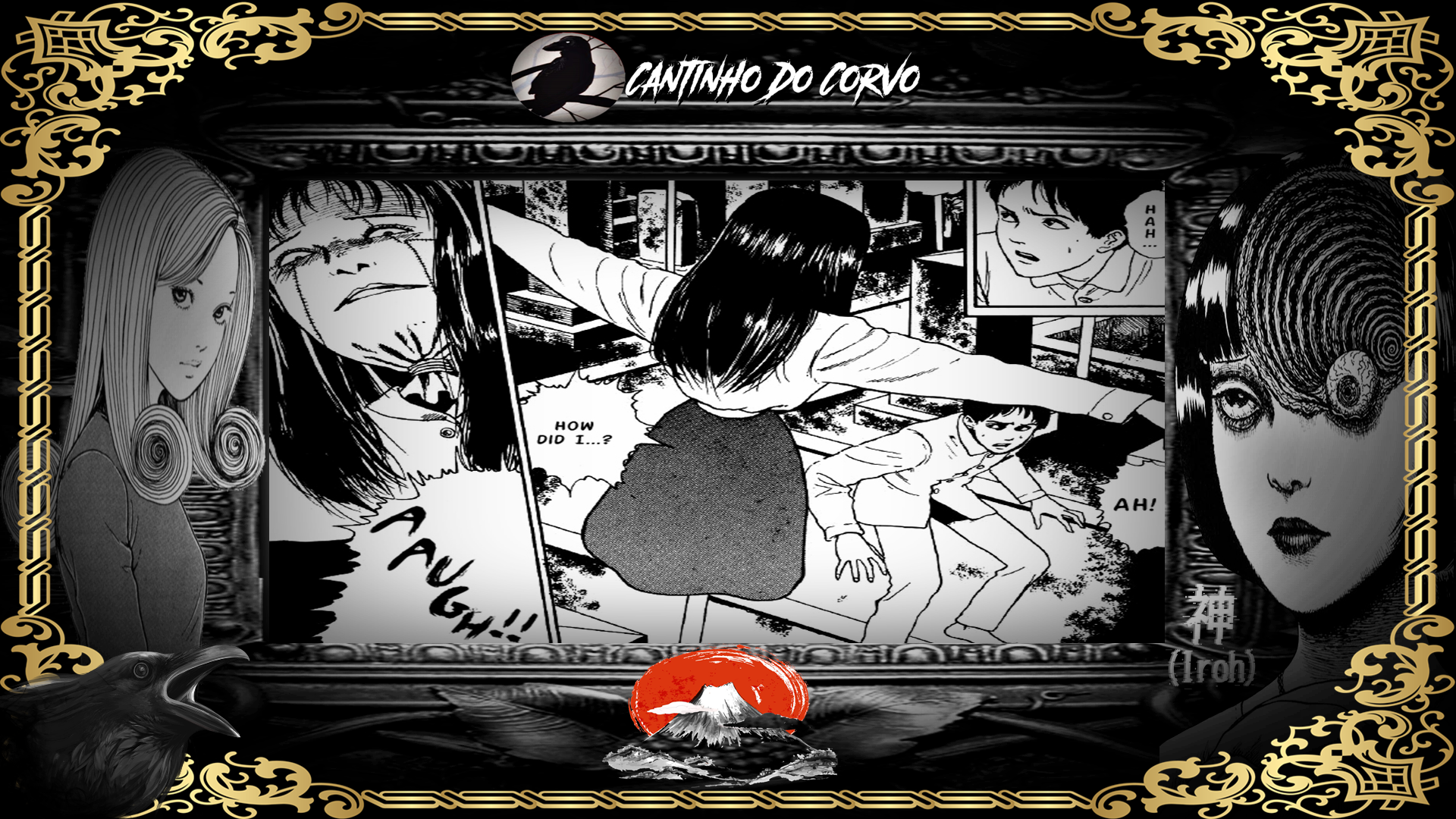
Junji Ito - Scarecrows: A grief not overcome


Hello my dears. I am the Raven who speaks to you.

In this video, I'll meditate on the short story called “Scarecrows”, written and drawn by the legendary mangaka Junji Ito. As usual, a recurrent and notorious feature of Ito-sensei, “Scarecrows” will present a supernatural story, with elements of the absurd, but which the author manages to insert into the factual world from the connection that the strange things he imagines are linked to typically human themes.

It is not my intention summarize or tell the story for you. The best appreciation is without a doubt reading and contemplating the graphical representation presented in the manga. But I rescue some elements of the narrative so that they can serve as an introduction for listeners to better understand my interest in discussing grief in this short podcast.

“Scarecrows” tells the story of two tragedies. One of them refers to Yuki’s suicide, committed after her father denied her the right to marry the man she loved. The father, day after day, visits her tomb in the cemetery and carries a huge guilt for Yuki's death. The boyfriend also makes frequent visits, but he encounters resistance from her father who mistreats and humiliates him, trying to prevent his approach to the tomb. Even with his daughter's death, the father apparently hasn't learned much. He even blames the boy for her death, outsourcing his responsibility and placing it on the lad.

The cemetery where Yuki was buried is next to a plantation, where naturally there are scarecrows whose function is to scare away crows and other birds that might want to approach. In an act of rage, Yuki's father pulls one of them off and sticks it on top of her tomb, in order to kick out the boy who shared a love with her, telling him that he was doing this because the scarecrow would shoo him like it did with the crows in the field.

Time passes and they leave. But the scarecrow still prostrate before the tomb. Upon returning the next day, the father notices that the figure, already frightening by nature, has begun to show traits of his daughter. It grew hair like hers. Day after day, the scarecrow reveals more characteristics of Yuki, never actually turning into a person, but gaining an appearance so similar that people who pass by the place come to believe that someone had made a scarecrow of Yuki, putting it in front of her tomb.

Emotional, the father forces the scarecrow to talk to him, but nothing happens. The only thing the scarecrow does is take on her features, making small eye movements and a pseudo facial expression. The father tries to take it home, but outside the tomb it goes back to normal, its original form. There is something about the environment, about the tomb, that transforms the scarecrow.

When the community becomes aware of the events, a predictable collective phenomenon occurs: everyone starts to make their scarecrows to stick in front of the tombs, hoping that they will take the form of their loved ones who are gone. The cemetery is no longer just a cluster of tombstones, but macabre scarecrows as well, dozens of them, all bearing human expressions.

From this brief preamble, I believe it is possible to reflect on this manga by Junji Ito. First of all, it's pretty clear to me that the element of grief is very strong. Saying goodbye to someone dear is not an easy thing, on the contrary: it is a very difficult process, which can take days, weeks or even months for the acute pain to gradually subside. This is definitely an element here. Yuki’s father frequent visits, motivated by pain and guilt, do not just fulfill a ritualistic function, one of respect: the visits to Yuki's grave have become the meaning of his life. Although the young woman passed away and made a split with earthly existence, the father's connection with her is still intense and permeated by a lot of suffering.

Some cultures, but not all, believe and encourage the good experience of grief. Funeral rites are performed not only because of the need to bury the dead, but also to say goodbye. As some people who share this belief often say, it's time to "let people go, their spirits migrate." There are many who believe that intense pain, the incessant desire to have a loved one back, the inability to move away from objects or mortal remains, or even the behavior of making the loss the center and sole reason for their existence, would be something that makes this transition process difficult. In other words, it would make it difficult for those who can no longer be here to actually leave. When scarecrows start to take on human features, that's something that comes to mind. The inability to overcome grief, the constant desire to reunite those who were lost is something that, somehow, keeps traces of them in this world. And, in this case, they ended up being reflected in the scarecrows, which served as modeling material.

Interestingly, Ito-sensei doesn't stop there. He will also work, in the manga, with the dimension of the trauma of death on the part of those who have died. In other words, those who died did not necessarily come out of this event unscathed. They may have been traumatically affected as well. Could the desire to find again those we lost be reciprocal? Could those who left nurture the desire to reunite? Furthermore, could those who died of unnatural causes be aware of this? Could they share human traits and feelings? And from that have individual motivations? Ito-sensei's manga is capable of let these question in the air.

But without a doubt the collective phenomenon caused by Yuki's scarecrow transformation is the most emblematic. It does point to dozens of poorly experienced grief, of several goodbyes that were not completely fulfilled. Of a dependency and lack never supplied. From a living and pulsating illusion that it would be possible to reconnect with loved ones. When people start to put their scarecrows in the cemetery, mothers taking children to meet the grandparents they never met and, at the same time, we readers see dozens of scarecrows with human features, but without the real ability to respond, to relate to each other, we are invaded by a gigantic feeling of malaise and even sadness. We reflect on the human condition, the fragility of our spirits. At the same time that we feel sorry for those poor people, perhaps this feeling is also transferred to our own reality. Is the blindness and hallucination caused by the pain and the inability to overcome, something that is only in the other people? What could also be dwelling in us, being reanimated, while we read and follow the story?

There is not a single answer to this question. Each one will respond according to their own experience with grief, loss and the way they deal with their own pain. “Scarecrows” is a manga that will affect people in different ways. And that might not even affect if the grief was done well or if the reader avoid to feel because of the fear that old pains and memories, repressed internally, might emerge.

Junji Ito has the ability to represent utopian things, which have no place in this world, in a way that is never safe. And this is what makes him so special, because while the elements are part of a utopia we are safe, they are merely part of a fiction and cannot touch us. But through its symbols and Ito's ability to make the unreal capable of invoking human themes, its creatures and oddities begin to be felt in the epidermis. They affect our minds, hearts and souls. It is when the utopian mixes with the real and, momentarily, enters the real world. The feeling of security is no longer a guarantee. And that's where the genuine horror comes from.

Corvid greetings!